





Live Chat

Domain Scan

(empty)

Login

You're Safe! How Our Always-Updated Infrastructure Protected You Against Recent PHP Vulnerabilities
(25-nov-2026)
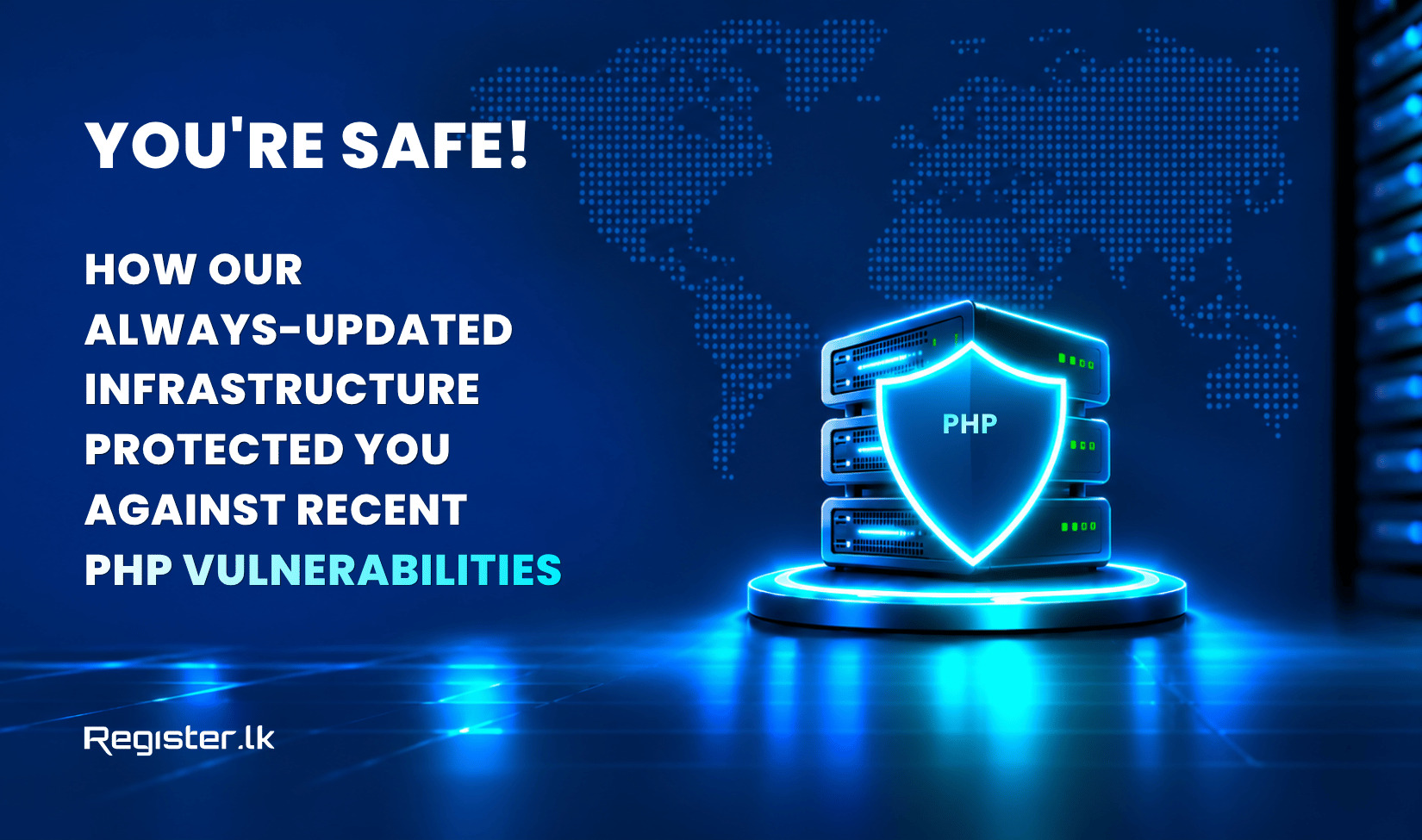
PHP is one of the most widely used server-side programming languages, powering millions of websites, content management systems such as WordPress, and various web applications. Unlike HTML and CSS, which primarily determine a website's structure and appearance, PHP runs on the web server to process requests, interact with databases, manage user authentication, and generate dynamic website content.
Because PHP executes application code on the server, vulnerabilities in the language itself can introduce significant security risks. If attackers discover a way to exploit a weakness in PHP, they may be able to execute unauthorised code on an affected server. Depending on the vulnerability and the server's security configuration, this could potentially allow them to compromise websites, access sensitive information, modify website files, or perform other malicious activities.
On 21 October 2026, two PHP vulnerabilities were reported that raised concerns about the security of affected systems. Vulnerabilities of this nature are particularly serious when they can be exploited remotely without authentication, as attackers may not need valid login credentials to attempt an attack. This highlights why keeping PHP versions up to date and applying security patches promptly are essential for protecting websites and maintaining a secure hosting environment.
A Closer Look at the PHP Vulnerabilities
The two critical vulnerabilities, CVE-2026-109618 and CVE-2026-109619, affect PHP versions 5.0 through 8.5.11. The PHP development team released security updates on 21 October 2026 to address these vulnerabilities.CVE-2026-109618
PHP uses its configurablememory_limit to restrict memory consumption. When memory allocation fails, PHP may abort request processing using an out-of-memory (OOM) handling mechanism. During this process, internal request data may remain only partially initialized. Subsequent cleanup operations can mistakenly treat this invalid data as valid and attempt to free or access uninitialized memory. An attacker can potentially trigger this condition through a specially crafted HTTP request, resulting in memory corruption and remote code execution.
CVE-2026-109619
This vulnerability occurs when PHP's internal global state retains references to request-specific memory after that memory has been freed. If a subsequent request is handled by the same PHP worker before the stale references are properly reset, PHP may access invalid or reused memory. This use-after-free condition can corrupt the runtime's internal state and potentially allow an unauthenticated attacker to execute arbitrary code on the affected server.Both vulnerabilities affect PHP's internal mechanisms, highlighting the importance of promptly applying security patches to affected PHP versions.
The patched versions released by the official PHP project are
PHP 8.2.35, 8.3.36, 8.4.27, and 8.5.12. Although PHP 8.1 and older versions no longer receive security updates directly from the PHP project, certain third-party vendors and Linux distributions may provide backported security patches for these versions. However, the availability and coverage of such updates vary by provider. Therefore, upgrading to a currently supported PHP version remains the recommended approach for maintaining long-term security and receiving ongoing security updates.
What These PHP Vulnerabilities Mean for Website Owners
These vulnerabilities are particularly concerning because they can potentially allow attackers to execute arbitrary code on affected servers without authentication. Successful exploitation could compromise website security, expose sensitive information accessible to the affected process, or disrupt website operations.The vulnerabilities affect PHP itself rather than a specific content management system or plugin. Consequently, websites built with WordPress and other PHP-based applications may be exposed if they run an affected PHP version.
However, the actual risk depends on the PHP version in use, the server configuration, and whether the relevant security patches have been applied. Keeping PHP up to date is therefore essential to reducing exposure to these vulnerabilities.
How We Responded to the Recent PHP Vulnerabilities
At Register.lk, maintaining a secure and up-to-date hosting infrastructure is a priority. When the two critical PHP vulnerabilities were disclosed on 21 October 2026, our shared hosting servers were already running PHP 8.2 and newer versions, helping us avoid reliance on outdated PHP branches.Following the release of the official security patches, we promptly updated the affected PHP versions across our hosting infrastructure to address the identified vulnerabilities. This proactive approach helps minimise the time our infrastructure remains exposed to newly discovered security threats.
Our customers benefit from these server-level maintenance efforts without needing to manually update the PHP installation managed by Register.lk. However, customers remain responsible for keeping their own website applications, plugins, themes, and other dependencies updated.
In addition to regular software updates, our hosting infrastructure benefits from multiple layers of security, including Imunify360, which helps detect and protect against malware and other potential threats. By combining timely security patching with additional protective measures, we remain committed to providing our customers with a more secure and reliable hosting environment.
Why We Keep PHP Updated and Remove End-of-Life Versions
PHP versions eventually reach end of life (EOL), after which they no longer receive regular security updates from the PHP project. Continuing to use unsupported versions can leave websites exposed to vulnerabilities that may never be patched upstream.At Register.lk, we proactively remove deprecated PHP versions from our shared hosting servers. In October 2024, we removed PHP 5.4, 5.6, and 7.0 - 7.4, transitioning the available versions to the PHP 8.x series. We subsequently removed PHP 8.0 and 8.1 as they reached end of life.
This policy helped us maintain a more current PHP environment. When the recent vulnerabilities were disclosed, our shared hosting servers were already running PHP 8.2 or newer, allowing us to focus on applying the released patches rather than dealing with unsupported PHP versions.
What You Should Check on Your Website
Although we maintain and secure our hosting infrastructure, customers should also take steps to protect their individual websites and applications.- Check for unauthorised file modifications: Look for unexpected changes to existing website files and investigate anything suspicious.
- Look for unfamiliar files: Check for newly created files or scripts that you did not upload or authorise, particularly in directories where they do not normally belong.
- Review your code for malicious injections: Inspect suspicious code, unexpected scripts, and unfamiliar or obfuscated content that may have been injected into your application.
- Keep your application updated: Update your CMS, plugins, themes, frameworks, and other dependencies to their latest secure versions.
- Strengthen account security: Use strong, unique passwords and enable two-factor authentication (2FA) wherever available.
Your Website Security Remains Our Priority
The recent PHP vulnerabilities highlight the importance of keeping server software up to date and responding promptly to newly discovered security threats. At Register.lk, we proactively remove end-of-life PHP versions, promptly apply available security patches, and maintain multiple layers of protection, including Imunify360, to help safeguard our hosting infrastructure.However, website security also depends on keeping your applications, plugins, and themes updated and following good security practices. We encourage our customers to use supported PHP versions, secure their accounts with strong passwords and two-factor authentication, and regularly check for unauthorised file modifications, suspicious new files, and malicious code injections.
By combining Register.lk's proactive infrastructure security measures with your own application security practices, we can work together to reduce security risks and maintain a safer hosting environment for your websites.
At Register.lk, we remain committed to keeping your hosting environment secure, up to date, and ready to protect your website against evolving security threats.
 Written by: Register.lk Support Hero - Shamendra
Related Articles


 31-Aug-2026
 07-Aug-2026
Safe & Secure Payments Accepted via: